
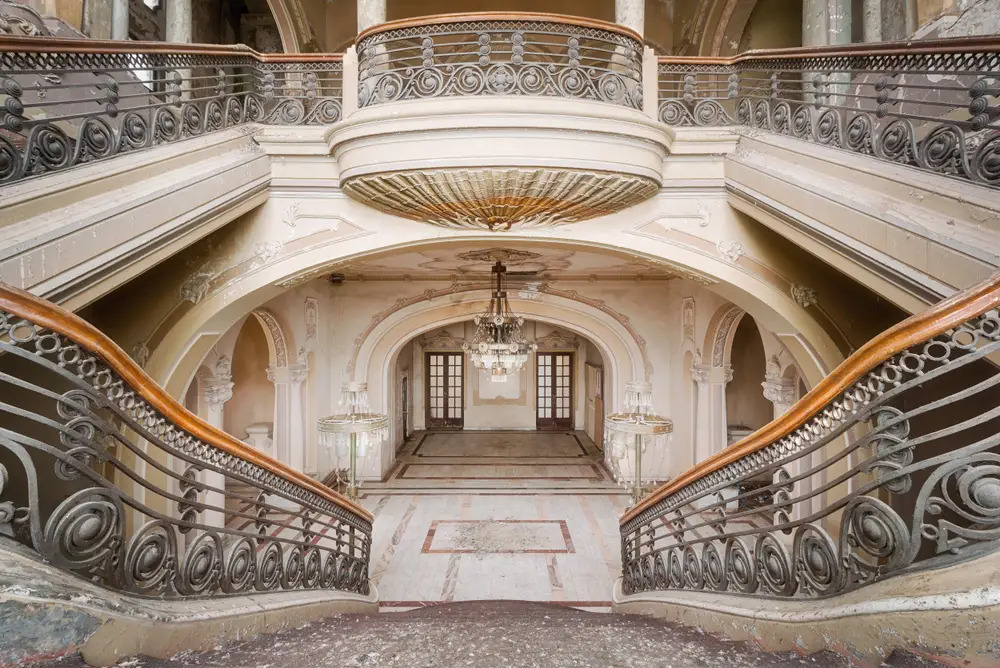
Dutch photographer Roman Robroek visited the abandoned Casino Constanta on the Black Sea coast of Romania and created a series of photographs documenting its interiors. The building, once considered the city’s foremost landmark, now presents an entirely different image. Robroek captured what remains of its former grandeur and shared these images with Business Insider.
Why He Is Drawn to Abandoned Places
Robroek has long specialized in photographing abandoned spaces. Empty factories, deserted estates, and forgotten public buildings form the core of his portfolio. Upon discovering the empty yet still majestic casino in Constanta on the Romanian coast, the photographer knew he could not pass it by. By his own admission, it is precisely the combination of architectural grandeur and the silence of abandonment that makes such places so compelling to photograph.
A Grand Art Nouveau Landmark
Casino Constanta holds a special place among the architectural monuments of the Black Sea region. Built in the Art Nouveau style, it became a recognizable urban landmark and a true signature attraction of Constanta. For decades, the building served as a grand drawing room for the wealthy visitors who came to the coast.
From Royal Commission to Grand Opening
The history of Casino Constanta begins with a monarch’s vision. Its construction was commissioned by King Carol I, who sought to transform Constanta into a respectable resort of European standing. The building was erected around 1900. A decade later, in 1910, the casino opened its doors to visitors and quickly earned a reputation as one of the most refined establishments on the entire Black Sea.
The Golden Age of Gaming and Dancing
During its heyday, the casino attracted wealthy travelers from across Europe. Evenings filled with gambling and dancing were held here, and a visit to Casino Constanta was itself considered a mark of social distinction. The building functioned not merely as a gambling house, but rather as a cultural and social hub around which the life of the seaside city revolved.
Robroek himself reflects on the significance the casino once held for Constanta and its guests.
“Many wealthy travelers enjoyed spending time gambling and dancing in this city landmark,” the photographer noted in conversation with Business Insider.
A Turning Point in 1990
The change came swiftly. In 1990, against the backdrop of sweeping political and economic upheaval in Romania, the casino was closed to the public. A decision that at the time likely seemed temporary turned into decades of neglect. The building was left standing on the waterfront without owners, without visitors, and without any clear prospect for the future.
A Slow Decline With No End in Sight
Since then, Casino Constanta has continued to deteriorate. Year after year, the salty sea wind, moisture, and lack of maintenance take their toll. The building remains closed, its condition steadily worsening. Once-luxurious halls are becoming spaces where peeling paint and crumbling plasterwork serve as the primary decorative features.
A Warning Sign for Other Land-Based Casinos?
The story of this magnificent building is a sad one. Yet in the future, this scenario may repeat itself — and more than once. The reason is that land-based casinos around the world are facing an unprecedented crisis in their history. The iGaming industry offers gambling enthusiasts what traditional gambling cannot. Here are just a few examples:
- The ability to play from home, directly from a phone or computer — all that is needed is a stable internet connection;
- Bonuses and promotions to attract players. As statistics from industry websites show, various no-deposit bonuses are particularly effective at capturing the attention of the target audience;
- Thousands of games unavailable in traditional casinos. Modern virtual gambling offerings resemble video games in design and gameplay, attracting a considerable number of gamers.
Under these conditions, land-based casinos must do everything possible to remain relevant in the face of pressure from digital gambling. A key factor in this effort is the offering of diverse non-gaming amenities. Moreover, no digital platforms can replicate the atmosphere of a land-based casino.