
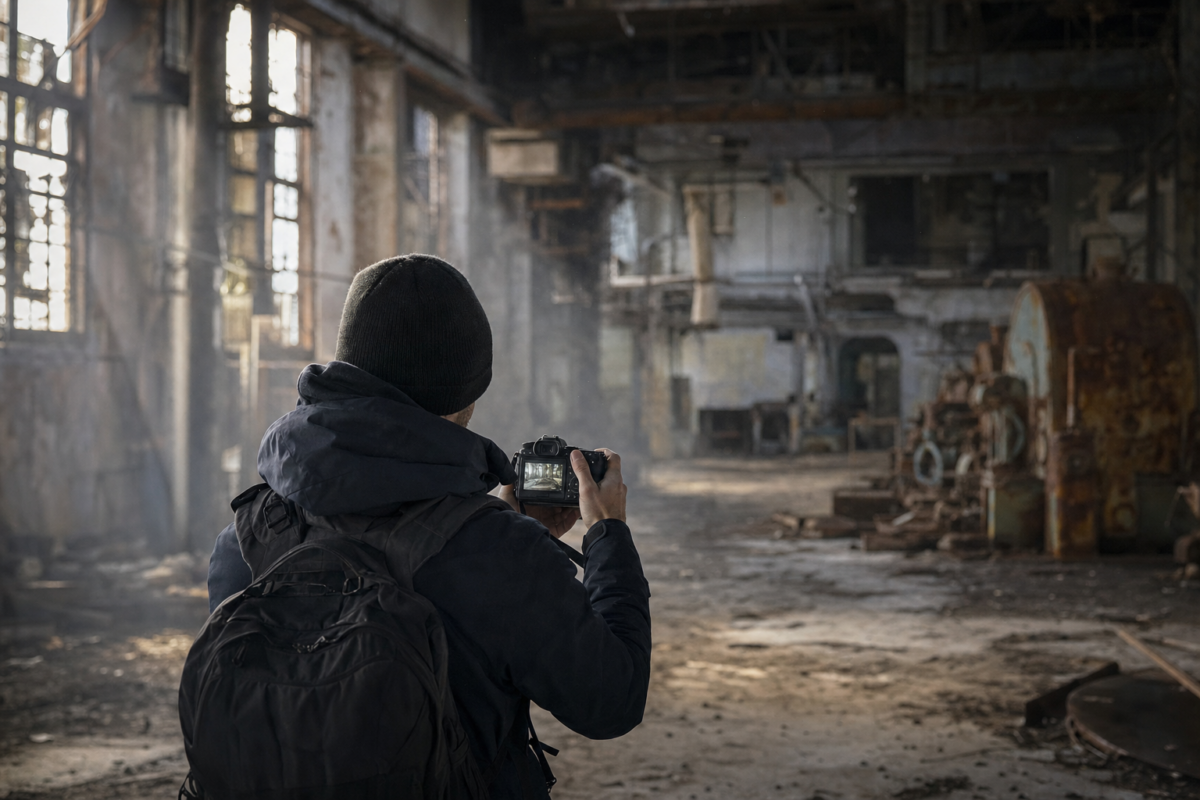
I have walked into hundreds of abandoned buildings with a camera and no idea what I would find. Most of the time the place is exactly what it looks like from the outside, a stripped-out farmhouse, a shuttered mill, a school with the gym floor buckling under years of rain. But every so often something feels off before I even raise the lens, and learning to trust that instinct has probably saved me more trouble than any piece of gear I own. It also taught me something I did not expect, which is how to tell a real photo from a staged one, and eventually how to apply that same suspicion to everything else I look at online.
Reading a Location Before You Ever Raise the Camera
Scouting is where the honesty test starts. A location that has genuinely sat untouched for a decade has a particular kind of decay, dust settles in patterns that match airflow, rust follows water lines, and the mess looks accidental rather than arranged. When I see a scene that is too tidy, a single chair positioned dead centre under a broken skylight, a doll propped just so on a stairwell, I get suspicious. Real abandonment does not compose itself for a camera. Explorers who set dressing before they shoot are not lying exactly, but they are shaping a story, and once you have seen enough real decay you start noticing the difference almost instantly.
Checking the Metadata Nobody Bothers to Fake
The other habit I picked up early is looking past the image itself. EXIF data, timestamps, even the reflections in a window can tell you whether a photo was taken where and when someone claims. I have seen shots recycled from a well-known Ontario asylum and passed off as a brand new find in another province, and the giveaway was always in the small details nobody thought to check, a light fixture, a stair railing, a crack pattern that matched a photo posted years earlier. Source checking is tedious. It is also the only thing standing between an audience and a completely fabricated story.
Spotting a Composite From Across the Room
Editing has gotten good enough that a heavily composited image can fool a casual scroll. What usually gives it away is inconsistency, shadows falling in two directions, a sky that is too perfect for the weather that day, colours that do not match the light source in the room. I am not against editing, most of my own work gets adjusted for exposure and contrast. The line I care about is whether the edit changes what actually happened in that room. A brightened corner is fine. A ghost added in post is a different thing entirely, and once you train your eye to catch one kind of fakery, you start catching it everywhere, not just in urbex photos.
How I Vet Real Money Casinos in Canada the Same Way I Vet a Location
That scepticism does not stay contained to abandoned buildings. It carries straight into how I read anything online that asks for trust before it has earned it. Comparison pages are a good example, since a lot of them recycle the same screenshots and claims across dozens of near-identical sites the way a faked urbex photo gets reposted with a new caption. Before I would take any of it seriously I would want to see who actually checked the underlying claims, which is why what Global News found when it dug into how those pages get put together carries more weight with me than a random listicle. A newsroom checking sourcing is doing the same job I do when I check a shadow angle, it is just applied to a different kind of picture.
Trusting the Whole Picture, Not Just the Frame
The habit that ties all of this together is refusing to take a single image, or a single claim, as the whole story. I want the surrounding context, the source, the history of who posted what and when. That applies whether I am deciding if a photo of a collapsed staircase is real or if a website’s claims hold up under a second look. In Ontario you have to be 19 to gamble in the first place, and if that kind of activity ever stops feeling like something you are in control of, ConnexOntario is there at 1-866-531-2600 with free, confidential support around the clock. It is the same instinct either way, slow down, check the details, and do not let a convincing frame talk you out of looking closer.
I still get fooled sometimes. Anyone who tells you they never do is probably not looking closely enough. But the more decayed buildings and doctored photos you pick apart, the harder it gets for anything, online or in an abandoned hallway, to slip something past you unnoticed.