
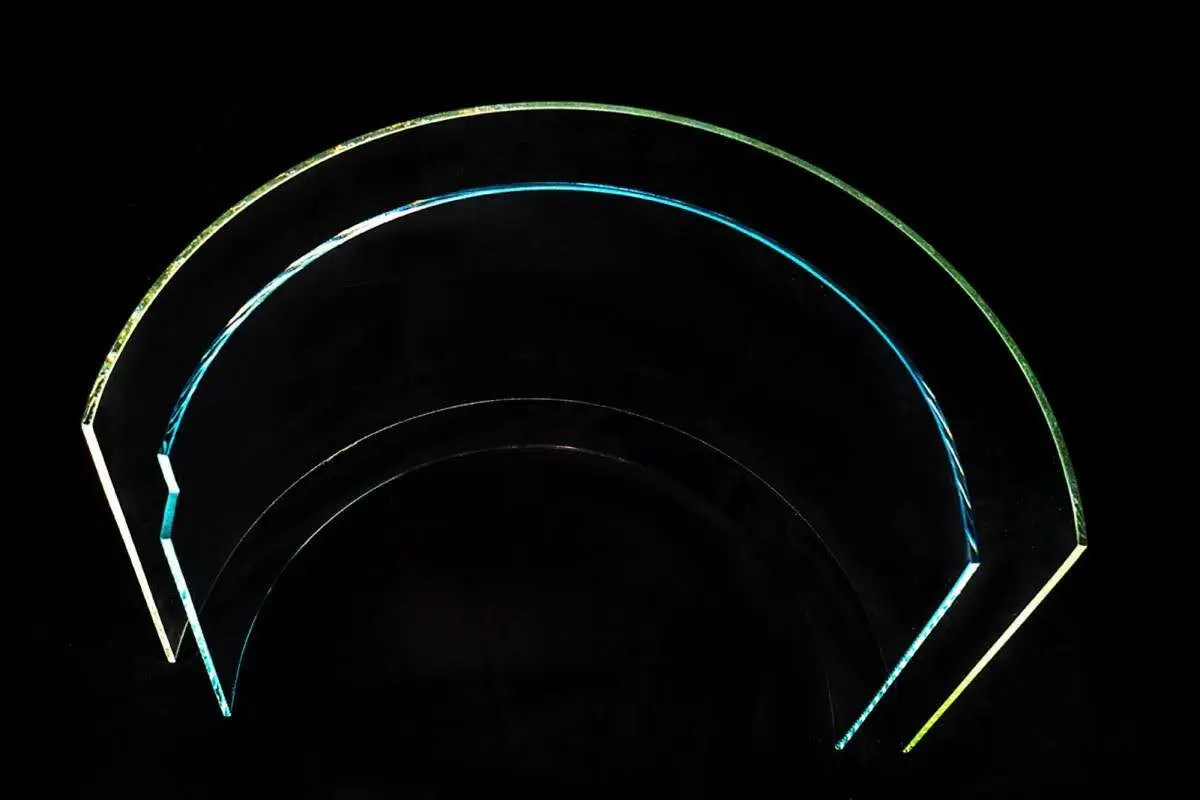
Wandering through the crumbling corridors of an abandoned hospital or stepping inside a long-shuttered department store, you’ll sometimes find yourself face-to-face with a ghost from another era: a weathered pane of curved glass. Maybe it’s part of a once-grand revolving door, a sweeping corner display window, or the remains of a mid-century solarium. Time has etched its marks across the surface—cracks spidering outward, grime clouding its once-clear view—but even in decay, curved glass still holds a sense of elegance. A relic of architectural ambition, now frozen in disuse.
Curved glass doesn’t just show up in ruins—it transforms them, quietly reminding us that these buildings were once alive with people, purpose, and pride.
Glass with a Vision: The Rise of Curved Glass in 20th-Century Architecture
Glass rapidly evolved in the 20th century, and curved glass became increasingly prominent in architecture, reaching its peak popularity during the Art Deco, Streamline Moderne, and mid-century modern movements. Its unique ability to soften corners and bring fluidity to building facades made it a favorite among architects aiming to signal innovation and modernity.
In urban cores, curved storefronts drew the eye—lending movement and openness to retail spaces. Department stores, banks, and pharmacies used curved display windows to guide foot traffic, creating panoramic views of merchandise without sharp edges or visual breaks. The 1950s and 60s saw an uptick in the use of curved glass in institutional buildings as well—train stations, hospitals, offices, and universities. These buildings often used curved curtain walls, entryways, and stairwell enclosures as a symbol of progressive design.
But as tastes changed and building materials evolved, these custom glass pieces became costly to maintain. By the 1980s and 90s, many were replaced with cheaper, flatter alternatives—or worse, left behind as buildings were boarded up and forgotten.
Today, many of these once-futuristic features sit in silence, hidden beneath graffiti and rust, slowly surrendering to time.
Scenes from Decay: Curved Glass in Abandoned Spaces
Urban explorers and architectural photographers have documented countless examples of curved glass trapped in suspended animation.
In an abandoned hospital, a once-pristine circular nurse’s station with curved glass windows now stands stripped and darkened, the glass fogged and etched by decades of neglect. The design once allowed for 360-degree visibility—efficient, functional, and beautiful. Today, the station feels more like a cold watchtower in a forgotten war.
In a long-closed train depot, you might find arched ticket counters framed in glass that once echoed the curves of arriving locomotives. The glass is cracked, yellowed, but still stubbornly intact—a testament to the craftsmanship that went into its creation.
In a Midwestern town, a once-bustling storefront sits boarded up, its curved display glass still holding strong despite broken doors and collapsed ceilings. There’s something hauntingly cinematic about it—like a time capsule built into the bones of a dying main street.
These moments, captured in dust and glass, speak to an era when buildings were built with pride and permanence. Even in their decay, these structures hold a certain dignity.
Why Curved Glass Was—and Still Is—So Special
Unlike flat glass, curved glass requires precision and patience to produce. The process involves heating flat glass sheets in a specialized kiln until they become soft enough to be bent over a mold. The glass must then be cooled slowly and carefully—a process known as annealing—to avoid stress fractures.
Because of the complexity and cost involved, curved glass has always been associated with high-end design. It conveys craftsmanship, modernity, and attention to detail. Even today, curved glass is a mark of architectural ambition—used in luxury retail storefronts, high-end residential buildings, and state-of-the-art commercial spaces. In restoration work, curved glass presents both a challenge and an opportunity. It’s rare, delicate, and often no longer manufactured in standard sizes. That’s why property owners and preservationists seeking to restore these details turn to curved glass artisans—specialists who can reproduce custom bends and finishes to match the original design for things such as curved windows. Replacing broken curved glass in a historic building is not just about aesthetics. It’s about preserving architectural integrity, honoring the original vision, and keeping a building’s story alive.
Today, many modern buildings, such as the Apple Park (Cupertino, California, USA), which is famous for the large 4-story ring-shaped office building with a curved glass façade, have kept the tradition of curved glass alive.
Curves That Tell a Story
Every pane of curved glass in an abandoned building tells a story. It’s not just a design flourish—it’s a snapshot of a time when buildings were meant to last, when even utilitarian spaces were designed with elegance and intent.
For urban explorers, spotting a piece of curved glass in a ruin is like discovering a signature from the architect, a hidden clue in the layers of decay. It hints at what the space once was—and what it might have been had it been preserved.
It’s no wonder that in the world of preservation, curved glass has become an object of desire. Artisans are now being called upon to recreate what was once mass-produced, reviving a craft that nearly disappeared. Because while the buildings may be crumbling, the curve endures—graceful, fragile, and unforgettable.
Whether behind a boarded-up storefront or embedded in a collapsing stairwell, curved glass remains one of the most hauntingly beautiful elements of forgotten architecture. It’s a testament to an era when detail mattered, and to the idea that even in abandonment, beauty survives.